Speed & Smarts: Approaching the Windward Mark
August 31, 2022
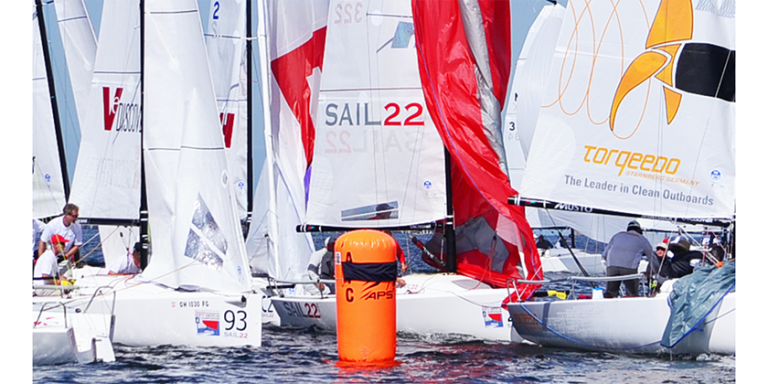
The windward mark is the first point where all the boats come back together after the start. It’s usually crowded and contentious and can have a significant impact on the outcome of the race. The tricky part is how you approach the mark – the key tactics here are to play by the rules, keep your wind clear and avoid over-standing the mark by too much. This is easy to do when you’re near the front (or back) of the fleet, but it requires some smart choices when you reach the mark in the middle of the pack.
Approaching the port-tack layline
I’m not opposed to approaching the windward mark on port tack. In fact, I do it a lot. There are usually fewer boats on the left side at the top of the beat, and this approach is often better than sailing in bad air, overstanding the mark or dealing with other problems found on the starboard-tack layline. But if you come into the mark on port tack you have to do it right; otherwise you risk disaster.
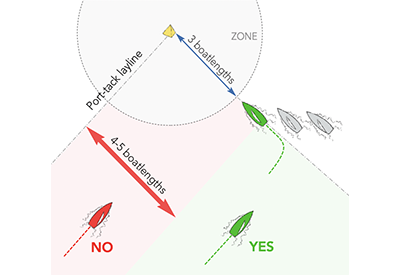
The most important tactical consideration is to avoid being on the actual port-tack layline to the mark. There are times when this approach can work brilliantly, but from a risk-management point of view, the closer you are to the port layline, the bigger your risk.
The primary reason is that the rules are stacked against boats coming in on port. They must keep clear of starboard tackers, of course, and they will have other problems if they tack inside the zone at the mark. Therefore, a basic rule of thumb is to be at least 4 or 5 lengths below the port-tack layline on port tack. This way when you tack near the mark you won’t be in the zone and you don’t have to worry about rule 18.3 (Tacking in the Zone).
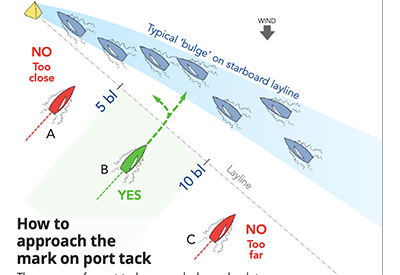 How to approach the mark on port tack
The success of a port-tack approach depends a lot on your position in the fleet. When you’re near the front, it’s easy to find a hole in the starboard-tack lineup, so you can come in to the mark at almost any distance below the port-tack layline. But when you’re in the middle of the pack, the point at which you reach the starboard layline is more critical.
Approach A – Too close to the mark.
When you arrive at the starboard-tack layline, don’t be too close to the mark. If you tack from port to starboard and pass head to wind inside the zone, you have a high risk of breaking rule 18.3 (Tacking in the Zone). In addition, the starboard-tack parade is pretty dense and close to the layline when boats get that close to the mark, so it may be impossible to find a gap where you can tack or a lane below the starboard tackers where you can tack and still fetch the mark.
Approach C – Too far from the mark.
When you reach the starboard layline on port tack, there are two places where you can tack: 1) on the windward side of all the starboard tackers, with clear air; or 2) to leeward of the starboard tackers, in bad air. If you’re too far from the mark, neither of these is a good option. The starboard tack lineup is usually well above the layline there, so going to windward of them means overstanding by a lot. There is usually room between the starboard tackers and the layline, but tacking there would mean you’d have to sail in bad air for too long.
Approach B – Just about right.
For many fleets and conditions, there’s a better compromise between roughly 5 and 10 boatlengths from the mark. This is far enough away so you won’t have a problem with rule 18.3, and there is usually room to tack below the starboard tackers and still be above the layline. It’s also close enough that you could survive from there to the mark in bad air if necessary. Warning! Beware of tacking below the line of starboard tackers when you are racing in light air or adverse current.
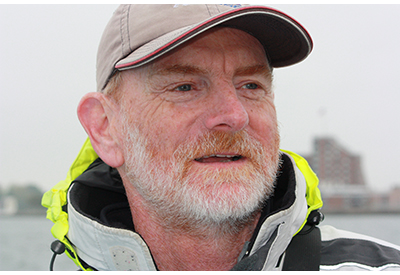 Dave Dellenbaugh is the publisher, editor and author of Speed & Smarts, the racing newsletter. He was the tactician and starting helmsman on America3 during her successful defense of the America’s Cup in 1992 and sailed in three other America’s Cup campaigns from 1986 to 2007. David is also two-time winner of the Canada’s Cup, a Lightning world champion, two-time Congressional Cup winner, seven-time Thistle national champion, three-time Prince of Wales U.S. match racing champion and past winner of the U.S. Team Racing Championship for the Hinman Trophy. He is currently a member of the US Sailing Racing Rules Committee (and was its chairman from 2005-2008).
You can subscribe to the Speed & Smarts newsletter HERE.