
Electronic Visual Distress Signals (eVDSD) is Accepted by Transport Canada
Jan 19, 2022
For a number of years, Sail Canada and Provincial Sailing Associations have been advocating Transport Canada in support of the approval of alternatives to the requirements for recreational boats to carry pyrotechnic distress signals.
The Small Vessel Regulations were recently amended to provide recreational boaters the option to carry certain communications equipment instead of a portion of the pyrotechnic signals (flares) required onboard their pleasure craft. During a consultation leading to these regulatory changes, Transport Canada was asked to accept electric signal lights as an alternative to pyrotechnics. At that time, there were no standards for electric visual signals that addressed the current technology. Therefore, electric visual signals could not be included in the amendments.
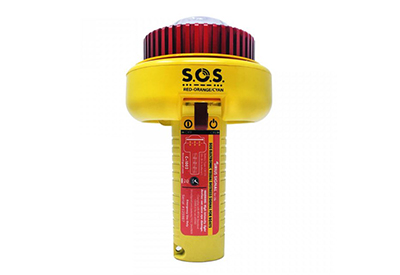
In November of 2021, Transport Canada announced acceptance of Electronic Visual Distress signals (eVDSDs). The Radio Technical Commission for Maritime Services (RTCM) in Arlington, Virginia has published a new industry standard for this equipment – RTCM13200 – using data from research done by the United States Coast Guard (USCG).
The standard addresses concerns related to visibility of certain LEDs to night-vision equipment. The standard does not include laser technology. Here are the technical details of RTC13200 – the new distress signal technology specification:
- displays a visible, two-color, flashing signal, plus a near-infrared component for detection with night-vision goggles,
- has an operating temperature range of -1°C to +30°C, and a storage temperature range of -20°C to +55°C,
- emits a 2-colour SOS signal, with the sequential repeating color/flash pattern: “S” as 3 red-orange flashes, followed by “O” as 3 cyan flashes, followed by “S” as 3 red-orange flashes,
- has a near infrared signal that flashes the same SOS signal in sync with the visible light signal for detection by night vision equipment,
- has an average effective intensity of at least 50 candelas for at least 2 hours.
In November 2021, Transport Canada announced that an eVDSD meeting RTCM13200 standard, when accompanied with a smoke signal would meet the requirements for distress signaling for Canadian Pleasure craft. Stated requirements are that device labelling be in English and French.
These devices should soon be available on the Canadian market. Sirius Signal produces a device that meets the RTCM13200 standard but as of yet is not available with labeling in both French and English.